Executive Presence & Influence
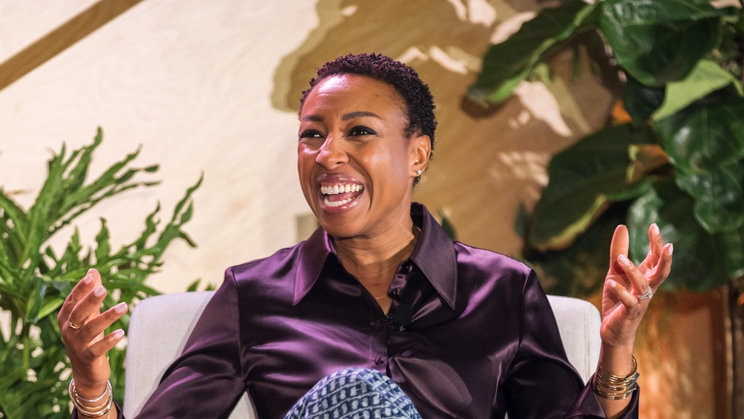
Tiffany Dufu knows what she wants her legacy to be.
“I feel very humbled because my life's work is advancing women and girls. That's pretty much why I wake up every morning, and I genuinely imagine and think about what my tombstone will say, which is: ‘She got to as many women as she could.’ Every day I'm project managing my way backwards from there.”
She’s well on her way: As a board member of Moms First and Girls Who Code, she’s fought for affordable childcare, paid leave, and opportunity for the next generation. As founder of The Cru, a peer-coaching tech company acquired by Luminary, she connected women with accountability partners to meet their goals. And, as President of the Tory Burch Foundation, she’s increasing their economic power by helping women entrepreneurs build businesses that last.
In 2025, the Foundation announced its goal to add $1 billion to the U.S. economy through the founders in its fellowship program and their companies’ collective revenue. As of 2025, their economic contribution has already topped $470 million.
Dufu — a Chief Member — joined us earlier this spring at SXSW for a conversation with Chief CEO Alison Moore about the common denominator that fuels this entrepreneurship, unlocks opportunity, and helps leaders create lasting impact: Community. Read on for her most powerful insights:
“Despite when anybody tells you about capital, which is very important, the most important resource that I ever had as an entrepreneur were other women entrepreneurs who were going through the same thing that I was going through. Fundamentally, there has to be a real sense of shared purpose that's beyond any one individual person.”
“When I had an opportunity to actually talk about the opportunity of running the foundation, what I most loved was this idea that every day I could get up and I could serve and support women who were doing something that I knew was extremely difficult to do. You know, conceiving of a concept of an idea, building it, creating it, going to market, growing it, and then ultimately exiting it — the hardest thing that I've ever done in my entire life.
“I've done lots of hard things in my life, but it's the hardest. And I think it's the hardest because, especially if you're a founder of the company, the growth of the company and the success of the company is so heavily tied to your own personal and professional growth as a human being. And the pace at which your company needs to grow is faster than the rate of normal human development, and so it feels very overwhelming. It's like a pressure because it's so attached to you. If you don't evolve and if you don't grow, your company doesn't evolve and your company doesn't grow. That really is the human endeavor.”
“Before I founded a company, I spent a lot of time as a social justice impact leader really fighting and arguing and making a case for why the people who I cared about, who were often more marginalized individuals, should have a bigger slice of the American pie, and I would make an important argument for that.
“When I started my company, I learned that I could create a whole other pie. I could create a whole new pie with its own culture. I could employ people. I could provide a place where people can really come and bring their full selves to the table. It was a whole other endeavor, and it was a really important point of privilege and power.
“When we talk about agency and we talk about privilege, because of the world that we live in, most of us are forced into slicing ourselves, dissecting our identities into different slices, and living in the most marginalized sections of our identity.
“So I walk into a room, they say she's a woman. I walk into a room, they say she's Black, she's a Black woman, and that's kind of the end of it. I really believe that the world would be better and that we would be better leaders if we rejected the slicing, and if we acknowledged and lived into all of the different parts of our identities, particularly the ones in which we have enormous privilege and in which our privilege can tread on someone else's humanity.”
“I grew up in a home where I was constantly affirmed. My opinion in my home was valid. It was listened to. My feelings were important in my home. So what does that mean? It means that when I walk into a room, I assume I should be listened to. It means I assume that I should be heard.It means that it would never occur to me that spending 30 minutes with Tiffany Dufu would be a waste of someone's time.
“I say that because I connect with so many women who are thanking me profusely for taking 30 minutes of their time, as if their time and who they are is not worthy. It's like, ‘I'm learning from you. I'm getting value from this time with you.’ I know a lot of women who have economic power, but they don't have agency power. They're not able to make the impact in the world that they could because they don't even understand how valuable they are in a room and that their voice matters.
“I don't have impostor syndrome — the idea that I don't belong somewhere — and that is probably one of the most pervasive privileges that I have that's allowed me to really create impact. If I could wiggle my nose like Samantha in Bewitched, and change that, and sprinkle it, that's what I would change.”
Executive Presence & Influence