Health & Wellbeing
A Mammogram Saved My Life Twice. It Was Only the Start
Dr. Carol DerSarkissian’s call to all women this Breast Cancer Awareness Month: Get the mammogram, then keep talking.
·8 min read
Chief Member Dr. Carol DerSarkissian is the founder of Parallel Med, a practice for women in midlife. She is a Menopause Society-certified physician and health strategist.
A mammogram saved my life. Twice.
I have a family history of breast cancer and I started getting yearly mammograms in my 30s. Twelve years ago, I received the news I was dreading. A “suspicious” finding. A biopsy. A 1 cm early-stage breast cancer.
Because my cancer was caught early and had not spread, not even to my local lymph nodes, I only needed a lumpectomy, radiation, and tamoxifen. Because my cancer was detected early I did not need chemotherapy or to take medicine to put me into menopause as treatment. I was extremely fortunate.
Nine months ago, a mammogram saved my life yet again. This time it found precancerous changes in both breasts. This time I chose a bilateral mastectomy with reconstruction.
I have been doing well since my initial diagnosis 12 years ago. I have been present for my children. I continue to have invaluable experiences with family and friends. Additionally, I have the privilege of being a doctor taking care of women in perimenopause and menopause where breast health is central to the care I provide.
So yes, get the mammogram. But my own story taught me what I now tell every patient: The mammogram is where the real, personal conversation begins.
Get the Mammogram
A mammogram is a low-dose X-ray of the breasts and our main screening test for finding breast cancer early, often before a lump can be felt. In 2024, the recommended age to begin mammograms every 1 to 2 years for women at average risk changed from 50 to 40 years old, reflecting rising breast cancer rates among women in their 40s. And catching it early changes everything.
Early detection means a smaller tumor, fewer, less aggressive treatments, and better odds of survival. I know those statistics as a physician. I lived them as a patient.
The recommendation to start mammograms at 40 is for women at average risk. Speak with your doctor for a personalized screening plan if you have had any of the following:
- Family history of breast cancer
- BRCA1/BRCA2 or other genetic variations
- Chest radiation at a young age
- Previous breast cancer
- High-risk breast lesion on a previous biopsy
I started screening in my 30s. I had a family history. I had no genetic variations or other risk factors. I hear the reasons women put off mammograms: It is uncomfortable, it’s scary, life is busy, and the one I hear the most: “No one in my family has had it, so I am fine.”
But most women diagnosed with breast cancer have no family history. Family history raises your risk. Its absence doesn't erase it.
A few minutes of discomfort. Years of life. That's the trade.
How to Read Your Mammogram Report
Oftentimes, my patients tell me that their mammogram is “normal” without the details of the report. But, beyond “normal” or “abnormal,” the details are the nuance of personalized care.
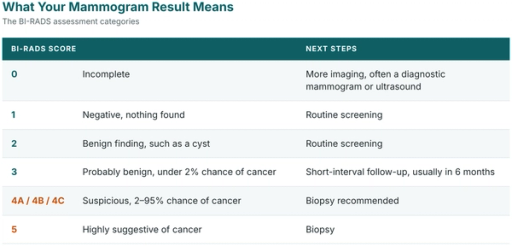
Your report carries two separate scores. One is your result, the other is your breast density. Both use the BI-RADS system and can easily be confused.
A number on your report isn’t an explanation. So here's what it means:
Now the second score: breast density.
Breasts are made up of fat, glands, and connective tissue. Since September 2024, every mammogram report in the United States must tell women their density category, from from A to D:
- A: almost entirely fatty
- B: scattered areas of dense tissue
- C: heterogeneously dense
- D: extremely dense
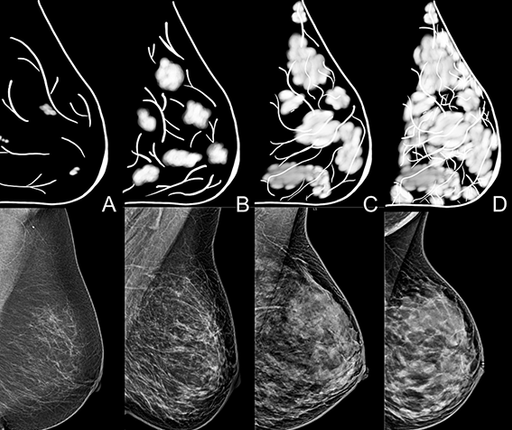
Categories C and D are considered dense and roughly half of women over 40 fall into one of them. This matters for two reasons.
First, dense tissue can hide cancer. On a mammogram, dense tissue looks white. So do tumors. The denser the tissue, the more a mammogram can miss.
Second, density itself is a risk factor. Women with extremely dense breasts can have up to four times the risk of women with mostly fatty breasts.
Dense breasts are normal and common. They are not a diagnosis, but they are a reason to have a nuanced discussion with your doctor. They’re also just one piece of the picture. To understand what it means for you, the next step is to calculate your lifetime risk of breast cancer.
What's Your Number? Calculating Lifetime Breast Cancer Risk
One in eight women will develop breast cancer in their lifetime. That's about 13%.
But that's an average. Your number could be lower. It could be much higher. That number is your lifetime risk, and it can be calculated.
Physicians use validated risk models to estimate your risk that consider factors including:
- Family cancer history of both sides
- Age of first period and menopause
- Whether and when you had children
- Past breast biopsies
- Breast density
Your number is a percentage, and 20% is the threshold.
At a lifetime risk of 20% or higher, screening recommendations change. Mammograms alone are no longer enough. Most guidelines call for adding an annual breast MRI. And your risk assessment may also need genetic testing.
The American College of Radiology recommends that every woman have a breast cancer risk assessment by age 25, not at 40 or after their first mammogram. Yet many women reach their 40s and 50s without ever knowing their number.
And knowing your risk isn't meant to scare you, it's meant to tell you what to do with it. Because if your risk is high, the next question becomes: What can you do about it?
Higher Risk? Your Supplemental Screening Options
If your lifetime risk is 20% or higher, supplemental screening can find what a mammogram misses.
This is in addition to your mammogram, not instead of it. Which test is right for you depends on your individual risk, breast density, and access.
Breast MRI is the most sensitive screening tool we have. It's the gold standard for women at high risk. It requires IV contrast and takes longer than a mammogram. The MRI and mammography are usually staggered so screening occurs every six months. Each scan detects cancers the other misses.
Contrast-enhanced mammography (CEM) is a mammogram with an IV contrast. It can detect cancers that a standard mammogram may miss.
Whole-breast ultrasound needs no needle and no dye. It's most often used for women with dense breasts. It is a good backup when MRI or CEM is not available, but it finds fewer cancers than MRI and is more likely to flag harmless spots that lead to extra tests.
Talk through which extra test makes sense for you with your doctor. Remember the extra test is in addition to your regular mammogram, not a replacement for it.
Does Menopausal Hormone Therapy Raise Breast Cancer Risk?
In 2002, one headline from the Women’s Health Initiative study scared a generation of women: hormone therapy causes breast cancer.
The real numbers tell a different story.
Combined estrogen plus progestin adds roughly eight breast cancer cases per 10,000 women per year, a real increase, but a small one. Small does not mean meaningless, especially if your baseline risk is already elevated. Which is why this consideration comes back to you: your breast cancer risk percentage, your symptoms, your health history, and your preferences.
If you've had breast cancer, menopausal hormones are generally off the table. But the treatments that protect you, like tamoxifen and aromatase inhibitors, can bring hot flashes, sleep issues, and vaginal dryness. I took tamoxifen. I know.
You shouldn't have to choose between protection and quality of life. There are nonhormonal medications that can effectively treat and reduce hot flashes. For vaginal symptoms, nonhormonal moisturizers help and low-dose vaginal estrogen is also safe and effective for most.
Surviving breast cancer is the goal. Living well afterward matters, too.
Three Questions to Ask Your Doctor
Twelve years ago, a mammogram found my breast cancer when it was small and treatable. Nine months ago, another one told me my story wasn't over. It was the start of a conversation with my doctors about my risk, my screening, and my options.
It put the decision back in my hands and I am doing well because of it. That's what screening can give you, and you deserve that conversation, too. Get the mammogram, then keep talking.
This month, ask your doctor these questions:
1. What's my breast density?
2. What's my lifetime breast cancer risk?
3. Given both, what's right for me?
Every woman carries their own story in their body. And sometimes the hardest part of medicine is accepting that there isn't one right answer for every woman, just the right answer for you.
Related Articles