
Work-Life Balance
I Keep a To-Don’t List. It Changed How I Work.
Your time is one of the most valuable things you have. Here’s how author and executive Fran Hauser suggests you spend it accordingly.

·5 min read
Fran Hauser is a longtime champion of women in the workplace and the author of Twenty Minutes Is the New Hour: The Ambitious Woman’s Guide to Doing Less and Achieving More and The Myth of the Nice Girl. A former President of Digital at Time Inc., she has invested in more than 40 female-founded companies and owns Bedford Books in Bedford, New York.
At this point in my career, I get far more requests and opportunities than I can say yes to.
That’s one of the wonderful problems that comes with more than two decades as an executive, investing in 40+ companies, serving on boards, mentoring hundreds of women, writing books, and speaking. There’s always another interesting opportunity landing in my inbox. And because I’m a recovering people-pleaser (anyone else?), my instinct is to consider every single one.
I used to spend far too much time agonizing over these decisions. Could I squeeze it in? Would I disappoint someone if I said no? Maybe it wouldn’t take that much time? I wrote a whole book about being a nice girl, so believe me, I know!
One of the best ways I’ve learned to protect my time has very little to do with managing it. It has to do with deciding in advance what I’m not going to do at all. I call it my “To-Don’t” list.
Meet Your “To-Don’t” List
I first came across this idea in Arianna Huffington’s book Thrive. She wrote about the satisfaction of crossing something off her to-do list simply by deciding not to do it. That fascinated me. We spend so much time thinking about what we need to accomplish. What if we became just as intentional about what we won’t?
So I created two “to-don’t” lists: one for work and one for my personal life. I started by zooming out and identifying the types of projects and commitments I wasn’t going to prioritize during this season.
Right now, my work “to-don’t” list includes investing in companies outside my existing portfolio and taking on new board seats. On the personal side, I’m not taking on leadership roles or running committees for my sons’ PTA.
Then I took it one step further. For the requests I knew would keep coming, I wrote templated email responses.
Now, when a founder reaches out about an investment opportunity, I send one of my pre-written emails. I don’t overthink how to respond. I made the decision when I was thinking clearly about my goals, before my people-pleasing instinct had a chance to kick in.
Want to create your own to-don’t list? Start with this:
1. Look at your calendar and to-do lists from the past three months. Notice anything you’re doing solely out of habit.
2. Ask yourself:
- Does this support one of my current goals?
- Is this a fundamental part of my job?
- Does this give me access to a valuable connection or opportunity?
- Does this bring me joy, and do I want to keep making time for it?
If you can’t answer yes to at least one, move it to your to-don’t list.
Your list will change as your priorities do. The goal is to decide what deserves your time during this season before everyone else decides for you.
Chronos and Kairos: Which One Is Running Your Day?
The more senior I became, the easier it was to fill my day with “unproductive” things that needed my attention. I could be busy from morning to night and still have no time for the work that moved my career forward.
Then my friend Bronwyn Saglimbeni, a communications coach, introduced me to two Greek concepts for time: Chronos and Kairos.
Chronos is time as we usually measure it. Think about your color-coded calendars, schedules, and to-do lists. (I happen to love all of these things, and I suspect you might, too!)
As leaders, we spend a lot of our days in Chronos. We move from meeting to meeting, respond to emails, approve things, and check boxes. We can finish the day having accomplished an impressive amount while mostly maintaining the status quo.
Kairos, on the other hand, is what the Greeks refer to as the opportune time when the stars align. It’s living in the present moment. At work, I experience Kairos when I’m completely absorbed in something that requires my full presence. I might be working on a book manuscript, preparing for a talk, or mentoring someone through an important decision.
I also find Kairos through what I call “passive productivity,” the space we give our brains to make connections without forcing them. It’s why some of your best ideas happen while you’re taking a walk or standing in the shower.
When I looked closely at my calendar, I realized I had become extremely good at Chronos time. But I wasn’t leaving much room for Kairos time, which is what moves my career forward.
Remember, there is zero correlation between being busy and creating value. The work that moves your career forward requires time to think, create, connect, and make decisions, not just check boxes off a to-do list.
The more senior you become, the more valuable your time becomes. Protect it for the thinking, decisions, relationships, and work that only you can do.
Give Your Best Hours to What Matters
I wrote my new book, Twenty Minutes Is the New Hour, for women who want to keep doing ambitious, meaningful work without letting it take over every available hour. It’s full of practical ways to find pockets of time hiding in your day and become more intentional about where you put them.
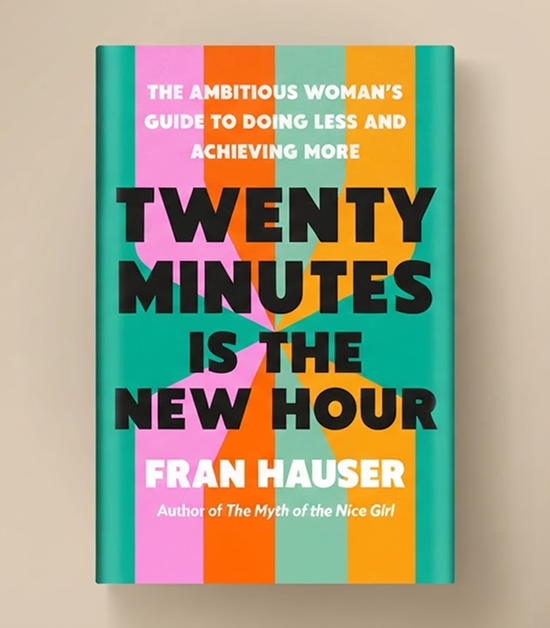
I spent years trying to figure out how to fit more into my days. These days, I’m much more interested in making sure the right things make it in.
Your time is one of the most valuable things you have to give. Spend it on the work, people, and parts of your life that deserve more of you.
Related Articles